In this part of the magazine we publish our weekly articles on the more common and new aircraft.
Issue 1
NHIndustries NH90
Words and pictures by our official writer Dave Sims
In 1992, NATO set out a requirement for a battlefield helicopter that would be able to excel in naval environments. The newly formed NH Industries (a collaborative company owned by EADS, AugustaWestland and Fokker) immediately began development of a new helicopter to fit the requirement and in December 1995, the first prototype which was labelled ‘PT-1’made its maiden flight.
The NH90 possessed several features that other medium helicopters such as the UH-60 Blackhawk and S-60 Seahawk (two of its direct competitors) did not, such as a rear ramp and a bigger load capacity. The NH-90 also boasted a fully integrated fly by wire system (the first helicopter to be fully fly by wire), and was corrosion proof to help protect the machine when it was operating at sea. Critically, the NH-90 was also competitively priced and cheaper to maintain than many of its competitors. This led to interest from several countries that wanted to use it for both naval and army operations, and the helicopter was soon being developed into two separate variants, the NATO Frigate Helicopter (NFH) for naval use, and the Tactical Transport Helicopter (TTH) for army duties
As the two variants became more distinguished from each other, more armed forces were able to see how these models could be tailored to their specific needs, and it wasn’t long before the orders started coming in. The development of these two variants took several years, and the first operational TTH helicopters were delivered to the German Army in December 2006.
Early concerns
On 1st June 2008, NH-90 ‘EI-202’ of 1 Gr Sq, Italian Army crashed into Bracciano Lake, near Lazio during an airshow routine. The pilot, Captain Fillippo Fornassi, unfortunately lost his life in the accident and the two other people on board were injured but survived and were rescued from the lake after the crash. This was the first (and to date the only) NH-90 to be lost in an air accident, and there has been no evidence to suggest the aircraft suffered any kind of mechanical failure. The incident did however initially raise some questions among countries that had the helicopter on order.
In 2010, German Army experts reportedly highlighted several issues with their NH-90 TTHs, stating that the seats could not support fully armed troops, and heavy infantry weapons could not be properly secured inside the aircraft. They also reported that the floor of the helicopter was prone to damage, that it could only really land on firm ground that was clear of obstacles due to its low ground clearance, and that the rear ramp could not effectively be used as most troops carrying a full quota of equipment exceeded the ramp weight limit.
In March 2014, the Dutch National Aerospace Laboratory identified that some of its navies NH-90 NFHs had suffered from fuselage wear and corrosion after long periods at sea. The DNAL pointed to the source of the problem sitting with design and assembly flaws during production. NH Industries launched an investigation to identify (and subsequently rectify) these shortcomings, and agreed to bear the cost of the repair of existing helicopters that suffered from this, as well as implementing fixes to their production lines to ensure future NH-90s were also protected. Although these issues delayed the production and further development of the NH-90, many countries have still adopted the aircraft, with only two countries cancelling their orders (Portugal due to the bite of recession and Saudi Arabia who instead opted for the Russian Mi-35 and Mi-17 helicopter platforms).
In April 2017, nearly all NH-90s operated by the Royal New Zealand Air Force were temporarily grounded after one was forced to make an emergency landing due to an engine fault. NH-90s have been criticized in New Zealand for their inability to be used in various conditions, although NH Industries state that the aircraft is fully capable of flying in all weather, day or night and at temperatures spanning from -40°C up to +50°C.
Versatility
One of the big selling points of the NH-90 is the ability for a single aircraft to do a variety of different jobs. The TTH variant for example can be configured for use as a VIP transport, a troop transport for up to 20 people, a cargo transport for over 5,500 lbs of material, and a CASEVAC platform. It can be used for airborne electronic warfare and airborne command post duties, as well as a search and rescue aircraft, and can even be used to drop paratroopers or to deploy Special Forces. These aircraft are also frequently used to train crew making them an excellent all-rounder for operators the world over. As of early 2017, NH Industries were reportedly in talks with some of its existing customers about launching a dedicated Special Forces variant of the NH-90. The NFH variant also boasts a multitude of capabilities for ship-borne deployments. These include anti-submarine and anti-surface unit warfare, maritime search and rescue, troop transport, anti-air warfare support, anti-piracy operations and Airborne Early Warning (AEW), as well as being used for the transport of goods and people between vessels.
Both versions can now accommodate door guns for use as battlespace support over both land and sea, and both use special composite material designed to not only protect the aircraft from ballistic damage, but also reduce the vehicles weight without compromising its integrity. The aircraft also has the smallest radar signature in its class due to features such as its unique fuselage shape and an infared suppression filtration system fitted to the engines exhausts.
With NH Industries delivering around 38 aircraft per year and over 300 aircraft delivered to date, the popularity of this platform despite early teething problems is evident. In early 2017 it was reported that 500+ airframes are on order from various countries. This is expected to take the current demand backlog for the aircraft past the year 2020, and with the possibility of a third (Special Forces) variant to come, NHI are optimistic that yet more customers will want to place orders in the coming years.
The Future
Vincent Dubrule, president of the NHI consortium, stated in December 2016 that the Special Forces variant of the NH-90 had been ‘defined, but not yet launched’, and said he hoped the new variant could be launched in the next ‘couple of years’. It was noted that 5 nations have already expressed an interest in this new version, and details have emerged around potential features of the as yet unnamed variant that include a trapdoor in the floor of the aircraft allowing for faster deployment of Special Forces troops, an enlarged rear opening in the rear ramp allowing for a rear gunner position, advanced Forward Looking Infared Radar (FLIR) equipment and state of the art digital datalink facilities, allowing instant data exchange with other airborne, land based and seaborne assets. It would also be likely to include some sort of reduced sensory visibility features, adding to the aircrafts existing stealthy attributes.
NHI also mentioned that the new variant (which would be adapted from the TTH model) could be offered as a new aircraft, and existing customers could also opt for a number of their existing TTH variants to be retro fitted to the SF model standard, making it more accessible to more operators.
With the NH-90 currently operating in various conditions all over the globe from the deserts of the Middle East, to the frozen landscapes of Northern Norway, the tropical humidity of the African jungle (on deployment with French and German armies) to the anti-piracy and SAR endeavours across the world’s oceans, and with hundreds more aircraft on order, it’s little wonder why this battlefield helicopter has become so popular. You only have to look at the likes of the UH-60 Blackhawk, which has been flying for over 40 years, to see how valuable these assets can be to military operations, and it seems likely that the NH-90 will enjoy similar success in years to come. NH Industries at least appear to have no plans to slow down any time soon.
In this this weeks article we take a look at the NH-90, a modern Medium sized Battlefield helicopter
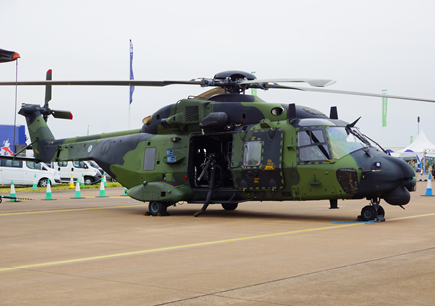
The helicopter was originally designed by NH Industries to primarily be a naval helicopter (as per the NATO specification), but it soon became apparent that the platform would also be an effective troop transport asset.
A Finnish Army example of the NH-90 TTH sporting a door mounted M134D gatling gun.

NH-90 NFH of the Royal Netherlands Navy. The Netherlands were the first country to receive delivery of the NFH variant of the NH-90 in 2010.
Other reported problems included the inability to door-mount a machine gun due to the requirement for troop movement, the lack of a hoist for fast-roping and paratroop equipment, and several issues relating to the compressor blade and spools in the engine, which suffered warp damage as a result of uneven cooling after engine shutdown (these last faults were identified by the Australian Dept. of Defence in 2011). Most of these issues were identified as being present in early design prototypes, and steps were taken by NH Industries to ensure that the issues were addressed for existing aircraft, as well as machines that were in production at the time.

NH-90 MTH ‘RN-08’ of the Belgian Air Component. Like the French forces, the Belgians named their aircraft the ‘Caiman’.
These features, combined with the multitude of avionics systems, sensors and extra equipment available make this an attractive proposition for countries looking for a modern medium sized multirole military helicopter. In fact, the NH-90 is currently in service with 13 nations including France, Belgium, The Netherlands, Germany, Italy, Finland, Greece, Norway, Spain, Sweden, Australia, New Zealand, and Oman, with Egypt and Qatar being the newest customers still awaiting delivery of their first NH-90s.
(C) Grant Fellows


(C) Adam Bassett


(C) Nick Cooke

(C) Tom Davies



(C) Steven Smith

(C) David Dilloway

(C) Rich Webster


(C) Christopher Wright


(C) Michelle Darlow



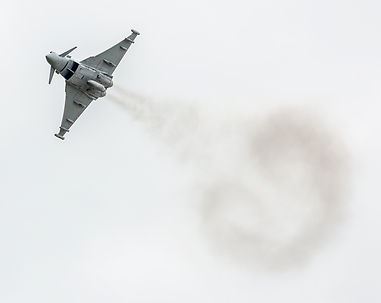

(c) Lee Carpenter / Carpenter Photography
(C) Simon Mears


Over the last 5 years, there have been reports of a number of mock up engagement during training exercises between Typhoons and American F-22 Raptors where the Typhoons are said to have come out on top. The United States deny this of course, but the Typhoon does have equipment that can in theory level the playing field against 5th aircraft such as the Raptor and the Lightning II. If this equipment does indeed prove to be able to negate stealth technology and help Typhoons to score wins in aerial combat against such opponents, could this be the unique selling point it needs to secure more sales in the current climate?
The Typhoon is equipped with the latest variation of the PIRATE (Passive InfaRed Airborne Tracking Equipment) sensor which is regarded as one of the best Infared Search and Tracking (IRST) systems in the world. This helps Typhoons see even stealth equipped aircraft by detecting variations in heat when at altitude. The engines of even the most advanced stealth aircraft still generate heat, and at altitude, heat caused by friction even builds up around the leading edges of an aircraft. In addition to this, the F-22 and F-35 do not carry IRSTs, relying instead on their stealth capability. This, coupled with the Typhoons best in class Radar systems and the proposed reduced operating costs, could lead to more interest from potential buyers who can’t afford Lightnings but need a capable fighter that could help defend against stealth aircraft if needed. Compared to the new F-35, the Typhoon is also faster, has the ability to carry more ordnance and appears to be far more agile which also helps with its appeal.
Although the future of the Typhoon is far from clear, there is evidently a lot of thought and effort being put into its continued development, and the platform remains available to export countries amid fierce competition. With advancements in stealth and counter-stealth technology continuing at an alarming rate, who knows whether the stealth advantage will even matter in 10 years’ time? After all, the difference between a generation 4.5 fighter and a generation 5 machine is literally its stealth capability; once that difference is removed both aircraft are essentially directly comparable.
There has even been talk of developing a thrust vectoring system for the Typhoons EJ200 engines, which would make the aircraft even more deadly to any adversaries, and although the likelihood of Typhoons engaging F-22s or F-35s in real life combat is very slim, it seems that other countries working on 5th generation stealth aircraft would have a lot to deal with if they ever had to engage one. Until then though, the Typhoon stands ready to face any mission that is asked of it, be it over land, at sea or in the air.

(C) Wayne Lewis
Your Photograph Submissions! :
--------------------------------------------------------------------------------------

Thank you to Wayne Lewis for the photograph above and the page background
This week we had some difference! Instead of us researching the provision of photographs we got our followers to provide their own, We had over 3000 total entries and so couldn't use everyone's unfortunately but well done to those who got their pictures used. (Check bottom of article to see your photographs)
Issue 2
The Eurofighter Typhoon
In the early 1970s, a requirement for a new fighter aircraft for the UK was identified. Similar plans to develop a next generation fighter aircraft by West Germany, France and Italy then led to a number of different collaborations and prototypes being built between the countries. By 1983 the Future European Fighter Aircraft (FEFA) program was established, consisting of the UK, Italy, Germany, France and Spain. The plan was to co-develop a fighter jet that could fulfil an array of air to air and air to ground capabilities, as well as deliver on requirements from the individual invested countries, such as a Short Take Off & Landing (STOL) and Beyond Visual Range (BVR) capabilities.
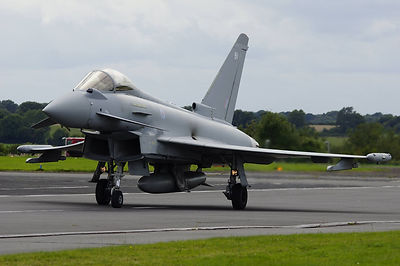
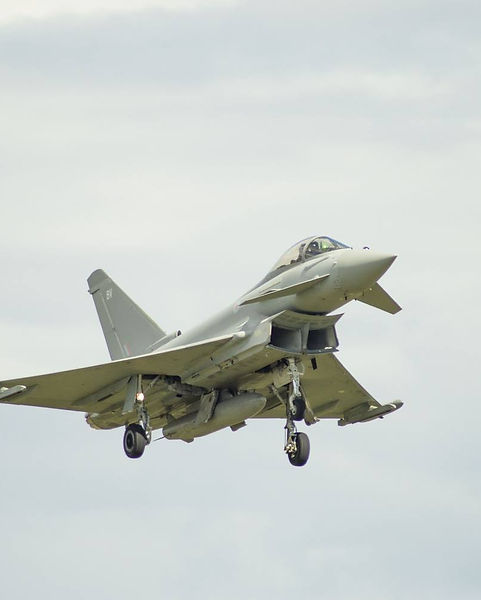
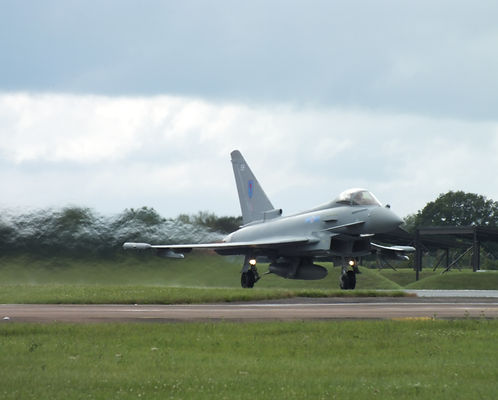
An RAF Typhoon Taxies to parking after landing. The PIRATE sensor is clearly visible here, mounted in front of the cockpit on the port side. (Credit to Dave Sims)
France also stipulated the requirement for a carrier borne variant, but the other countries were not keen to pursue this, and after further disagreements about creative control of the project, France eventually left the programme in the summer of 1985. Soon after, the programme was renamed the Eurofighter Project and the four remaining countries continued working on the new aircraft while France began the pursuit of their own next generation fighter (initially known as the ACX, this would eventually become the coveted Dassault Rafale). In 1986 BAe Systems produced an early prototype aircraft (known as the EAP) which had an uncanny likeness to the aircraft we now know as the Typhoon. (This was essentially the first working platform that went on to be developed into the Eurofighter. The EAP prototype itself can be seen on display at the RAF museum at Cosford).
By the early 1990s, Eurofighter had become a far more expensive project than the contributing countries had estimated. Financial commitments with Germany’s reunification following the collapse of the Berlin Wall and the demise of the Soviet Union meant that Germany could not afford to contribute to the project as much as it had committed to, and even tried to pull out of the programme altogether (albeit unsuccessfully). There were delays to the development of the aircrafts design too, with different countries unable to agree on various parts and systems to be used, the share of work to be done by each country and various political positioning by the governments of the different countries. The prototype (known at the time as the Eurofighter 2000) finally took to the air for the first time in March 1994.
Development of the aircraft continued despite further delays and funding difficulties, and by January of 1998, the first production contract of the new aircraft was eventually signed. In September 1998, the aircraft was formally named Typhoon (interestingly, the name ‘Spitfire II’ was also initially considered but got rejected, and it is thought that to this day Germany don’t refer to their aircraft as Typhoons but EF2000s because they don’t want to associate the aircraft with the Hawker Typhoon that was used to attack German targets during the second world war).

Showing of its diverse payload capability, the Typhoon can engage air and ground targets in a single sortie (Credit to Dave Sims)
In 1988, the initial cost estimation of the development of the Eurofighter for the UK was set at around £7 billion. By the time the first aircraft were delivered to the RAF, the project was 4 and a half years behind schedule and was reported to have cost the UK over £37 billion.
Typhoon finally takes off
The first Typhoon deliveries began in June 2003, with aircraft being accepted by the four partner nations. Typhoons wouldn’t begin entering operational service with their squadrons until 2005 with the partner nations, and the first exported Typhoons were delivered to the Austrian Air Force in July 2007, with deliveries to the Royal Saudi Air Force 2 year later. In December 2012, an order for 12 Typhoons were placed by the Omani Air Force, and in April 2016, procurement of 28 Typhoons was requested by the Air Force of Kuwait. By April 2017 a total of 500 Typhoons had been delivered to partner nations and export customers, with approximately 124 more on order, which includes 160 aircraft operated by the UK, 143 by Germany, 121 by Italy and 73 by Spain. The biggest export customer is Saudi Arabia with 72 aircraft (including those still to be delivered).
The first combat mission flown by Typhoons came during the Libyan conflict of 2011, when aircraft from both the RAF and the Italian Air Force flew ground strike and reconnaissance missions over the North African country in support of ISAF forces. Both countries also immediately put their Typhoons to work as their assigned Quick Reaction Alert (QRA) aircraft upon the aircraft achieving operation capability, in Italy in 2005, and with the RAF in 2007. Since their introduction to their respective air forces, Typhoons have become a mainstay in the skies over Europe, and the backbone of many of their host nation’s primary fighter force. Development of the aircrafts systems and capabilities still continue to this day, and the RAF Typhoons have as recently as July 2017 begun testing with the latest MBDA Brimstone air to surface missile. The current iteration of the Typhoon in RAF service, the FGR4, is expected to take over the air to surface role from the Tornado GR4 force when the Tornado is retired in 2019, with the F-35 Lightning II and the Typhoon due to share air to air and reconnaissance responsibilities.
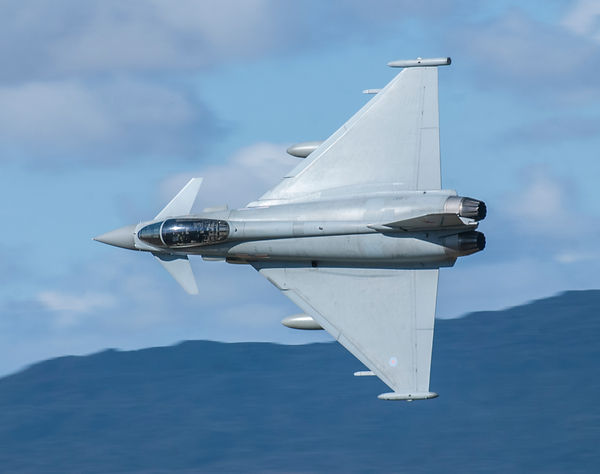
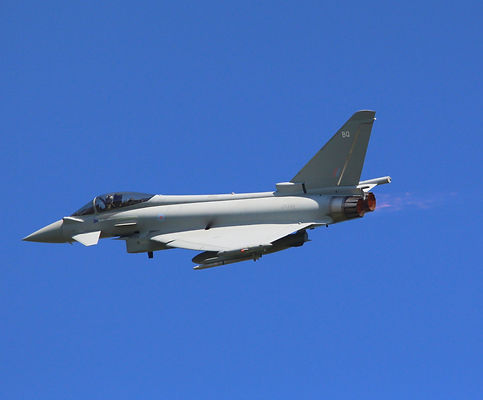
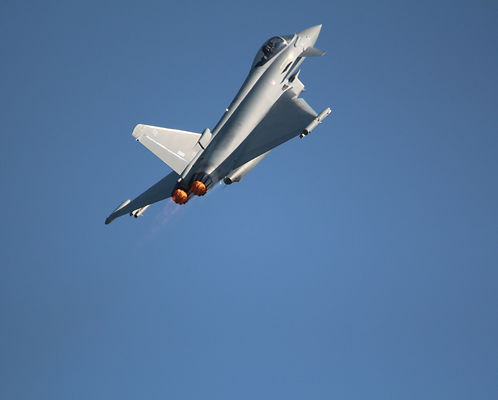
RAF Typhoons on QRA duty currently see regular action due to unannounced aircraft encroaching into UK airspace, most often this being TU-95 Bear bombers of the Russian Air Force. The aircraft boasts a high level of manoeuvrability due to its large delta wing surface area and the canards mounted aft of the nose of the Typhoon. It is able to achieve speeds of up to Mach 2, and can ‘supercruise’ (sustain supersonic flight without the use of afterburners) at Mach 1.5. The aircrafts performance is also aided by its twin EJ200 engines that can generate in excess of 40,000 lbs of thrust between them, and the composite material that makes up a large amount of the fuselage, making the Typhoon relatively light for its size. The aircraft can carry payloads of up to 20,000 lbs and can carry different combinations of munitions across its 13 external hard points, allowing it to carry payloads for different missions in one sortie. The array of weapons it can carry is also continuously expanding, with the most recent additions to the arsenal being the Brimstone, the Storm Shadow cruise missile and the Meteor air to air missile.

An Italian Air Force two seat trainer variant of the Typhoon shows off its air brake

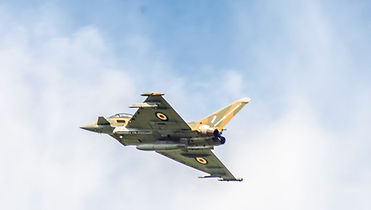
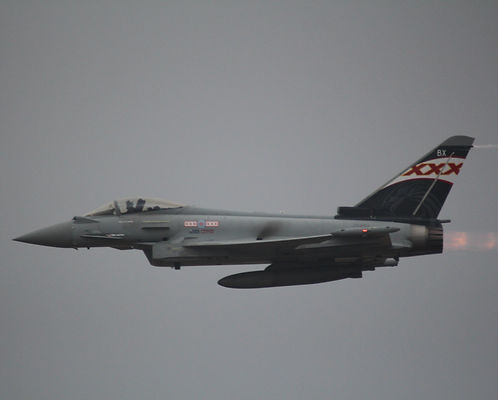
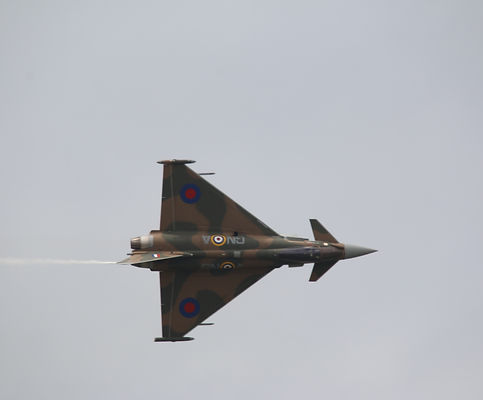
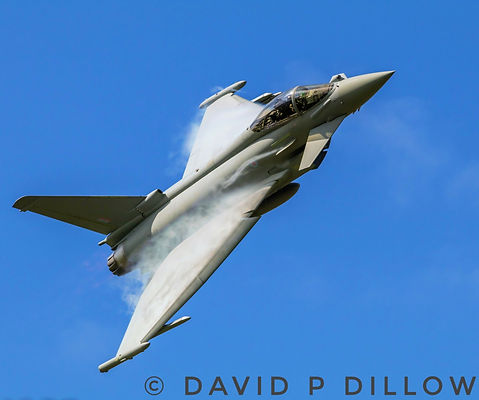
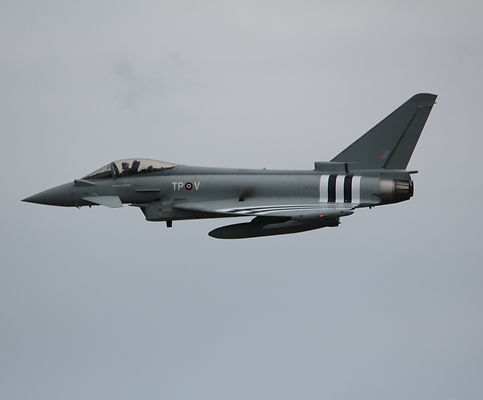
Special paint schemes on Typhoons are not uncommon on the European airshow circuit
Typhoons have developed into being an excellent all round multirole fighter. For example, a pair of Typhoons could be sent on a sortie carrying combinations of air to air, air to ground and targeting and sensory equipment between them, as well as range extending external fuel stores. They would in a theoretical situation be able to travel to a target area, conduct reconnaissance over the operational theatre and feedback data to allied forces, provide air superiority cover if needed, and then persecute ground targets before heading home. Although the Typhoons combat radius only amounts to 750 nautical miles (with 3 external tanks), the aircraft does have the capability to take on fuel in flight from an air tanker, which can in theory extend the typhoons range exponentially if needed, making the platform even more flexible.
Tiffie on the world stage
The Typhoon, affectionately know as the ‘Tiffie’ by many, has several direct competitors in the world market. Not least is the French Rafale, essentially born from the same original idea, which has very similar capabilities but boasts a lower operating CPH (Cost Per Hour), as well as a carrier capable variant. Other peer aircraft include the Swedish Saab Gripen, another highly capable delta winged fighter, the Russian built Sukhoi SU-30, (an export variant of the extremely popular SU-27 family), and various offerings from America including modernised versions of the F/A-18 Hornet and, of course, the Lockheed Martin F-35 Lightning II.
Austria have also recently announced that they are to withdraw their fleet of 15 Typhoons by the year 2020, stating operating costs as a major part of their decision to do so. In July 2016, in response to criticism over high operating costs, BAe Systems announced they were aiming to reduce the operating cost of the Typhoon over the coming years so that will eventually equate to it having a per-hour operating cost similar to that of an F-16. This could also have been in response to the large amount of orders for the F-35 in an attempt to lure some customers away from the Lightning II (The F-35 is likely to have a far higher operating cost than even the Typhoon).
Stealth Killer?

(C) Wayne Lewis
Although the Typhoon currently serves with 6 air forces, with deliveries to 2 more in the not too distant future, there are a number of potential buyers who have either postponed making their decision on purchasing the Eurofighter, or have backed out and gone with another option altogether. These countries include the likes of Belgium, Canada, Finland, Indonesia, Poland, India, Japan, Qatar, Singapore, South Korea and Turkey among several others. The majority of countries who were initially considering procuring the Typhoon have instead opted for the F-35 in its various guises, mainly due to its stealth & STOVL (Short Take Off, Vertical Landing) capabilities.