Welcome to our BRAND NEW Magazine.
We promise our Aviation Magazine is like nothing you've read before and it will interest you with every word. We would like to thank all of our volunteers who work on maintaining , writing, editing, evaluating, photographing and publishing of our Episodes.

Issue 1
In 1928 the Directorate of Civil Aviation introduced a new aviation registration sequence in the UK, which started with the code G-A. The very first aircraft to be designated with a registration was the de Havilland D.H60G Gipsy Moth, serial number 805, and owned and operated by Geoffrey de Havilland himself. The aircraft gained the registration G-AAAA on 30th July, and the aircraft was also fitted with a cockpit canopy in October the same year.

In July 1928, Geoffrey de Havilland also broke the light plane height record, when he flew his Gypsy Moth up to an official altitude of 19,980 feet. Some even speculate that he reached a height of up to 21,000 feet that day.
G-AAAA On the ground before it's cockpit conversion
We would like to thank our Official writer , Dave Sims for his great work on researching and writing the story of G-AAAA. You will definitely see more of his work in the coming days.
G-AAAA de Havilland D.H.60 Gipsy Moth
On a cold and windy morning in early July 1929, de Havilland entered the Gipsy Moth in the Kings Cup, a two day point to point race beginning in Heston, Middlesex, and travelling to various cities across Britain including Bristol, Glasgow, Norwich and Birmingham among others. The race finished back at Heston and de Havilland (designated as no. 36 for the race), finished 9th overall. The race (won by Flight Officer Richard Atcherley in a Gloster Grebe that year) is still contested annually to this day, and de Havilland did go on to win the race in 1933 in a Leopard Moth.
Between 1930 and 1935, G-AAAA was used by the AA to air drop messages to road patrols who would wait by roadside telephone boxes. In June 1935, the aircraft was acquired by Air Hire Ltd, based at Heston, and was sold on to an FJ Bush in 1937. The Yorkshire Aeroplane Club then took ownership of AAA in December of 1938.
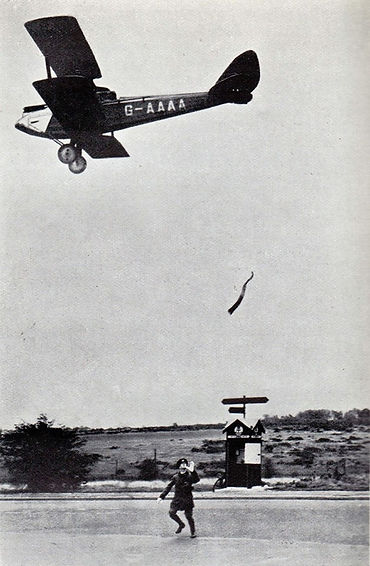
In November 1939 as war broke out, G-AAAA was impressed into RAF service and given the registration X5038 and sent to the 24 Maintenance Unit at Ternhill. Then in February 1940 AAA was repurposed as a decoy, eventually going to Sound City Films in December 1940 where it would apparently spend the rest of its days.
G-AAAA certainly had a fascinating and varied career. From breaking world records to serving with the RAF, racing in the Kings cup and flying for the AA, as well as having the honour of being the first aircraft on the new civil register and being Geoffrey de Havilland’s personal steed, it’s safe to say this little Gypsy Moth earned its place in the history books.
Issue 2
G-AAAB Supermarine Solent
In 1926, The Royal Danish Navy approached British Aircraft manufacturer Supermarine with a requirement for a flying boat that could deploy torpedoes in flight. Supermarine, who had already enjoyed success with its Southampton flying boat (that was used primarily as an aerial reconnaissance aircraft), quickly set about designing and building a single prototype and the completed aircraft made its maiden flight on 21st June 1927. The aircraft (construction number 1244 and originally named the Supermarine Nanok) used the Southampton’s tried and tested fuselage design, but featured three engines instead of the Southampton’s two.

Sporting Royal Danish Navy colours and carrying a torpedo, the aircraft undergoes evaluation at the Supermarine factory in Southampton.
The trials of the new aircraft didn’t go smoothly however, and although they made several changes to the aircrafts features during testing, they were unable to get the aircraft to reach the levels of performance the Danish Navy required, and the order was cancelled.
In 1928, Supermarine decided to rename their aircraft the ‘Solent’ and tried to sell it as a torpedo bomber to the wider market, but had no success. With apparently no appetite from any air arms or navies for this type of torpedo bomber, Supermarine decided to convert the Solent into an air yacht (essentially a civilian private flying boat which was popular among rich businessmen at the time), and it was eventually sold to Arthur Ernest Guinness, the brewing magnate in August of the same year.
The aircraft shared the same biplane wing design and wing mounted floats as the Southampton, but unlike its predecessor, Supermarines new torpedo bomber did lack any landing gear, making it a purely waterborne aircraft (this was to reduce weight so it could accommodate the torpedoes).
The Solent was registered as a civilian aircraft upon its acquisition, gaining the registration G-AAAB. Guinness used the aircraft to travel frequently between his home in County Galway in Ireland and England for both business and leisure trips. The Solent however was still not held in very high regard by its owner, and Guinness soon ordered a replacement, the newer and more powerful Supermarine Air Yacht which was finished in 1930 (This aircraft was a very similar design to the Solent, and Guinness actually rejected the Air Yacht from Supermarine and instead bought a Saro Cloud, which proved to be a far superior and more successful flying boat than either of Supermarines offerings). After just 2 years in service, Guinness replaced the Solent and it was never flown again. The aircraft was withdrawn from use in July 1931 and eventually scrapped in 1934.
In an era when flying boats and amphibious aircraft looked to be the future of aviation, the Solent fell short of exceeding in any department. With enough time and development, this short lived design could have become rather successful, but the extraordinary pace of technological advancement in aviation at the time meant that the Solent’s outdated design, along with her painfully underpowered engines and lack of amphibious capability led to her ultimate demise and refined her to a unremarkable yet fairly unique corner of aviation history.
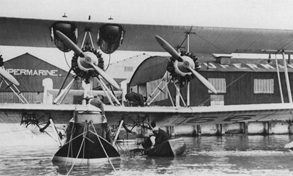
Engineers work on the torpedo rails as the aircraft sits in the water.
We would once again like to thank the wonderfully talented Dave Sims for his second article on the team.
Issue 3
G-AAAC de Havilland DH60X Moth
The third aircraft that was granted a registration on the civil aviation directorate of 1928 was that of de Havilland DH60X Moth, construction number 694, which was registered as G-AAAC.
The aircraft was registered privately with a J Thompson in August 1928, before being sold to Charles Ward in September 1931. The aircraft then went to Phillips & Powis Aircraft Ltd in January of 1932, and in August of the same year, it reportedly crashed at Mousehold airfield in Norfolk.

There are no surviving photographs of G-AAAC unfortunately however here is a similar DH60 Moth
Although no details of any damage sustained are recorded, it is thought that the aircraft was repaired by a company called Airwork Ltd, based out of Heston. AAC then changed hands again in February 1933, this time becoming part of the Norfolk & Norwich Aero Club which was based at Mousehold.
In April 1935 G-AAAC was sold to Air Travel Ltd, finally being relocated to their base at Penhurst in June 1936. Air Travel was then sold in September 1937 and the aircraft became part of Airports Ltd, based just down the road from Penhurst at Gatwick airport. In August 1938, AAC again changed ownership when it was sold to Redhill Flying Club. On arrival at Redhill, it was noted that G-AAAC now sported a newer and more powerful Gypsy I engine, although the exact date of when this upgrade took place was not recorded.
The Moth stayed with Redhill Flying Club until the early part of 1941, where it was impressed into RAF service as DG587. In February 1941, the aircraft was sent to 20 Maintenance Unit at Aston Down for a brief time, before being stationed with No. 3 Service Flying Training School at South Cerney from May 1941. The Moths journey would end on 13th August 1942 after it reportedly crashed on attempting to land at South Cerney airfield during a training flight and was damaged irreparably. Although both crew members aboard that day escaped without serious injury, it is unknown if there was much left to salvage from the aircraft wreckage that could have been used on other aircraft.
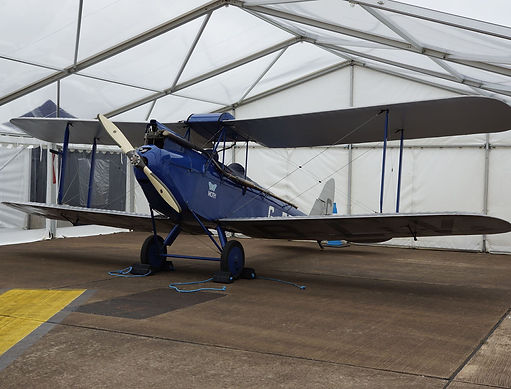
Here is a modern day replica photograph taken by Dave Sims at RIAT 2016.
Once again we thank our wonderful staff writer Dave Sims for his piece.